


The Links at Spanish Bay™

Rating Snapshot


About
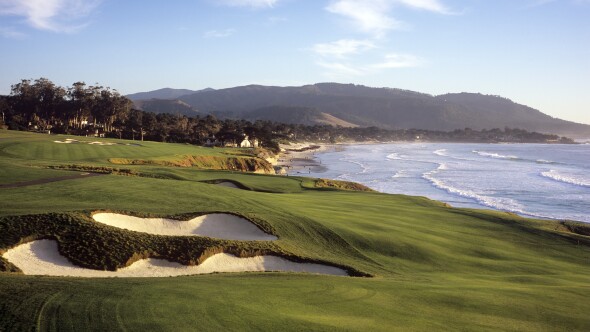
Designed by Robert Trent Jones, Jr., Tom Watson and Frank "Sandy" Tatum, The Links at Spanish Bay™ is America's foremost Scottish-style linksland course; even the rugged Monterey coastline mirrors the natural beauty of Scotland.
From the rolling fairways, white sand dunes and gusting winds to the plaintive strains of the bagpipe that signals the end of each day's play, The Links at Spanish Bay™ is an elegant, challenging journey into golf's beginnings.
| Tee | Par | Length | Rating | Slope |
|---|---|---|---|---|
| Blue | 72 | 6754 yards | 74.3 | 142 |
| Gold | 72 | 6420 yards | 72.4 | 135 |
| White | 72 | 6043 yards | 70.4 | 131 |
| White (W) | 72 | 6043 yards | 76.4 | 141 |
| Red (W) | 72 | 5332 yards | 72.3 | 129 |
| Red | 72 | 5332 yards | 67.6 | 115 |
| Hole | 1 | 2 | 3 | 4 | 5 | 6 | 7 | 8 | 9 | Out | 10 | 11 | 12 | 13 | 14 | 15 | 16 | 17 | 18 | In | Total |
|---|---|---|---|---|---|---|---|---|---|---|---|---|---|---|---|---|---|---|---|---|---|
| Blue M: 73.8/143 | 500 | 308 | 344 | 185 | 454 | 397 | 423 | 160 | 390 | 3161 | 510 | 376 | 425 | 124 | 567 | 392 | 200 | 402 | 582 | 3578 | 6739 |
| Gold M: 72.4/135 W: 78.8/144 | 489 | 296 | 336 | 176 | 416 | 378 | 416 | 155 | 364 | 3026 | 477 | 351 | 415 | 117 | 540 | 374 | 191 | 363 | 574 | 3402 | 6428 |
| White M: 70.7/131 W: 76.7/141 | 461 | 267 | 311 | 157 | 405 | 355 | 387 | 146 | 348 | 2837 | 464 | 317 | 402 | 96 | 533 | 367 | 156 | 342 | 523 | 3200 | 6037 |
| Green M: 69.3/123 W: 74.5/137 | 448 | 248 | 304 | 148 | 385 | 344 | 358 | 136 | 342 | 2713 | 437 | 310 | 370 | 88 | 503 | 335 | 144 | 336 | 484 | 3007 | 5720 |
| Red M: 67.3/114 W: 71.9/129 | 429 | 219 | 270 | 124 | 348 | 292 | 348 | 127 | 318 | 2475 | 404 | 279 | 333 | 72 | 471 | 290 | 125 | 306 | 463 | 2743 | 5218 |
| Handicap | 9 | 13 | 5 | 15 | 1 | 11 | 3 | 17 | 7 | 8 | 14 | 6 | 18 | 2 | 12 | 16 | 4 | 10 | |||
| Par | 5 | 4 | 4 | 3 | 4 | 4 | 4 | 3 | 4 | 35 | 5 | 4 | 4 | 3 | 5 | 4 | 3 | 4 | 5 | 37 | 72 |
| Handicap (W) | 5 | 13 | 11 | 15 | 3 | 9 | 1 | 17 | 7 | 10 | 14 | 4 | 18 | 2 | 12 | 16 | 8 | 6 |
Course Details
Rentals/Services
Practice/Instruction
Policies
Food & Beverage
Snacks, RestaurantAvailable Facilities
Clubhouse, Conference Facilities, Banquet Facilities, SpaAvailable Sports
TennisReviews
Reviewer Photos
-
par 3 8th Photo submitted by GRaleigh on 08/16/2022
-
9 green Photo submitted by GRaleigh on 08/16/2022
-
14 fairway Photo submitted by GRaleigh on 08/16/2022
-
12th hole approach Photo submitted by GRaleigh on 08/16/2022
-
16th par 3 Photo submitted by GRaleigh on 08/16/2022
-
Photo submitted by GRaleigh on 08/16/2022
-
Par-3 fourth hole Photo submitted by BrandonWebb on 08/12/2017
-
Par-5 first hole Photo submitted by BrandonWebb on 08/12/2017
-
Par-5 first hole approach view Photo submitted by BrandonWebb on 08/12/2017
-
Par-5 14th hole Photo submitted by BrandonWebb on 08/12/2017
-
Par-4 seventh green Photo submitted by BrandonWebb on 08/12/2017
-
Par-4 fifth hole Photo submitted by BrandonWebb on 08/12/2017

Disappointing
Played the course for the first time in a few years today. Remembered it being a really well kept challenging course. While it’s still challenging it’s definitely not as well kept. Lots of sand on the tee boxes and fairways. Lots of wet and bare patches in fairways. Greens bumpy and inconsistent( early a.m. tee time so shouldn’t be an issue, I understand in the afternoon after a days golf and growth they tend to worsen )
$110 between 2 people for a shared cart is ridiculous especially after paying $335 to play the course.
Probably be another few years before I’m back, if ever.
Really Good not Great
If you balk at spending $500+ for a round of golf 17 mile drive might not be the place for you. However for $315 Spanish Bay feels like a bargain. First the good if you want ocean views and a faux links experience Spanish Bay delivers in spades. now the criticism some holes at Spanish Bay offer more of a target almost desert golf like vibe vs links. The environmental areas require hitting to some Islands and the edges are lined with really thick heavy rough to keep the ball from rolling into the dunes. When the wind picks up especially on the back 9 hitting from thick rough from one island over a waste area to the green is not for the faint at hear or weak of wrist. Ironically my favorite hole and maybe one of the best on 17 mile drive was the long par 4 12th up in the pines that requires a mid iron or hybrid second shot to carry a barranca in front of the green but there is plenty of room around the green to miss just not short. The staff and service were top notch everyone was super friendly, the food was good and the bar and patio overlooking the ocean and the bag pipers is a top 10 golf experience anywhere. Spanish Bay would be the best golf course a lot of people would every play so I rated it 5 stars, however it's probably the weakest on 17 mile drive over all. I heard it might be getting renovated which would be exciting because the setting is as good as anywhere in the world. Now that I have played it before going back I would spend that money and play twice at Poppy Hills or Bayonett/Black Horse which are nearby and excellent Monterey experiences as well.
-
par 3 8th Photo submitted by GRaleigh on 08/16/2022
-
9 green Photo submitted by GRaleigh on 08/16/2022
-
14 fairway Photo submitted by GRaleigh on 08/16/2022
-
12th hole approach Photo submitted by GRaleigh on 08/16/2022
-
16th par 3 Photo submitted by GRaleigh on 08/16/2022
-
Photo submitted by GRaleigh on 08/16/2022
Great course
Where to start,
Me and my 10 friends were excited to play the course for the first time. But we didn't expect the rude treatment from some the staff for the price of $315. At the bag drop off, the staff was lazy and didn't offer to help unload our golf bags and pull cart. He just stood their and told us we can carry our bags down the walking path. Then the starter told me he's going to call us 5mins early before our tee times, but he totally forgot and started yelling at us to tee off right away. Then on the 2nd hole, the Marshall told us we needed to pick up the pace and that we're two holes behind the group in front, which wasn't true. And then on the 12th hole, the Marshall said we're two holes behind and that he was going to call the head pro and have us skip a hole. So we hurry and finish the hole to find the group in front of us we're just hitting their balls onto the green. And it gets worse. A group behind one of our group bombed up on them. So one of our players told the Marshall about it, and said, "Well you're 20mins behind pace". This was so unprofessional of him, and what suppose to be a great memorable golf outing ended up turning into an unpleasant day. But for some reason, the younger staffs that works their has been really nice to us. With all that said, you would expect to get the 5-Stars treatment for that sticker price , but I will never be coming back here again.
Must play, bucket list!
If you like sand dunes and endless views of the Pacific, Spanish Bay can't be missed!!!
The 1st hole sets the tone for the day. This gentle downhill par 5 takes you right to the ocean. Arguably a tie with Sheep Ranch for the best starting hole.
Tough, target course. The variety of holes and quality of amazing routing helps you forget the beating you are taking. Love how the course stays by the ocean for most of the front nine, then goes inland, and then back to the Pacific to finish.
Disappointing
Lumpy,slow greens.Cart path only on half of holes.Directed off course sometimes 100 yards before the green so difficult approach shots.Not quality
Cold and windy links
This is a challenging course. Narrow and short fairways with lots of out of bounds due to environmental sensitive areas. The views are breathtaking, the greens are tricky, the fairways are well manicured. It makes it even more challenging when it's cold and windy. They have a nice bar to enjoy a glass when you finish. Cheers!

Decent Day
Very much looked forward to the round that day as it was part of a 10 golf trip. Pre-game was excellent and the facilities were great.
Issue with greens as they aerated everything that day after being told only 4 would be - ruined a perfect day as we could not experience the true golf course.
Head Professional looked after us post round after I wrote a letter. Will definitely go back.
If you have fog on Hole 1 don't worry - it adds to the experience throughout the day!!!
Underrated
Spanish Bay is the "little lost" brother to the two courses Pebble Beach and Spyglass. It has just as many views of the ocean and is a more user friendly layout for the average golfer. I highly recommend it after playing all three courses within three days.
Overzealous Ranger
5 1/2 hour round due mostly to the wind. The layout and course conditions were excellent. Not sure what other golfers were seeing regarding the conditions, but the course was in great shape.Much of it was along the water and the windy conditions were difficult but it's part of the game.
My only complaint would be the overzealous ranger who warned us several times to speed up play when it was not us causing the hold up. Ruined an otherwise very enjoyable day. The Director of Golf was informed and very apologetic and did compensate us, which was not our intention but appreciated.
great course, bad grass
Took my Dad for his 80th b-day. Loved the course, layout and staff, but feel ripped off by the course conditions.
The fairways had very little grass. I hit many fairways yet had to move my ball many times to find grass to hit my approach from. See bare spots in picture attached. This fairway was one of the better ones. Equally obnoxious was that half the greens had been pinned and top dressed with sand. They still rolled ok but looked like my local muni in the spring time.
I booked my tee time the day of, but was told about neither the greens nor the fairways. I leaned about the greens on the first tee. The starter said we wouldn't even notice the pinning. Umm, we noticed.
I played poppy hills two days later. Poppy was much less expensive and in perfect shape. I told one of their staff about the Spanish Bay conditions and he speculated that the Pebble consortium has been diverting water from Spanish Bay to Spyglass and Pebble due to drought. That's fine, but it is clearly not OK to charge full price when you know your course is in a compromised state. The Pebble trio used to be on my bucket list. Not any more.
Gorgeous Course, but Not One of My Favorites
First, it was very windy and chilly the day we played. It is already a tough course and played much harder under the conditions. Played as part of the 4th of July Stay and Play package they were running.
Front 9 was a blast. The Back 9 is the same hole repeated. AND they are redoing the grass around the 17th and 18th greens so within 20 yards of the greens, they were unplayable. And at the Pebble pricepoint, that is lame.
The scenery could not be any more beautiful, though. Great staff, EXCELLENT food.
Great Golf w/ Scenic Views
Went out with some friends to enjoy a nice winter day on a nice course. Course conditions are excellent right now with perfect greens that roll at a medium fast pace but are soft and hold approach shots. Sand traps and fairways are great as well but the tee boxes stole the show. It was like teeing up on perfectly flat smooth carpet.
We walked the course and there are a couple of long transfers between a few of the holes. Hand carts are allowed but you have to provide your own. Remember, the course is cart path only.
Being right on top of the ocean for most of the course you have spectacular scenic views of the surrounding Pacific Ocean and across the bay to Santa Cruz. In fact only three holes don't have views of the ocean.
Customer service is top notch. For some reason customer service is better here than Pebble Beach. At Pebble you get the sense that they HAVE to treat you well (and darn right they do for that price) but at Spanish Bay you get the feeling that they WANT to treat you well.
Spanish Bay also has the best clubhouse of the three. Spyglass is purely about the golf. It has an old building that seems like an afterthought more than anything else. Pebble has fantastic amenities, but you have to share them with every tourist who just came off the bus.
Spanish Bay has separated their facility so the non golfing tourists are over at the hotel 500 yards away, yet it has a fantastic restaurant / bar with outdoor seating overlooking the ocean and first hole just for the golfers.

Spanish Bay vastly underrated
Spanish Bay's more famous sister courses up the 17-Mile Drive receive more attention, but I found this to be perhaps the most fun to play of the three. Pebble has the history. Spyglass has the teeth. Spanish Bay offers a wealth of strategic plays, wind-judging club choices and tricky green complexes.
Though many courses in the U.S. bill themselves as "links golf," Spyglass offers a true authentic links experience. The turf, wind, proximity to the ocean and variety of shot-making ability solidifies this.
I thoroughly enjoy any course that does not blindly require players to pull driver off virtually every non-par 3 tee. Spanish Bay is certainly a great example. I hit a bevy of 4- and 5-irons off the tee and remarkably two 8-irons! This was critical to not only being in the right spots off the tee, but to avoiding the many environmentally-sensitive areas that are predominate throughout the layout. If your ball finds one of these areas, you must drop and not try to retrieve it.
A few greens featured dramatic complexes, but I found the majority of the greens to offer more subtle breaks. You must be aware of where the Pacific Ocean is in relation to your ball on virtually every putt.
Bump-and-run chip shots will be a valuable skill here. Closely mown areas make this a good option, while thicker rough does collar the borders of greens. Your bunker game will be put to the test as well.
Perhaps my favorite feature of Spanish Bay is the post-round experience. There is a fantastic 19th hole that offers outdoor seating with fire pits that lie alongside the first tee and provide remarkable views of the first hole and Pacific Ocean. At 5:45 pm a bagpiper closes out the day beginning on the first tee, and walks the first fairway toward the Inn. It is a fantastic, goosebumps-raising experience not to be missed.
Bottom line: Taking into consideration that I've played Chambers Bay, but have yet to visit Bandon Dunes or Whistling Straits, Spanish Bay and Kiawah's Ocean Course offer the best American links golf experiences that I have encountered thus far, and is highly underrated in my opinion.
-
Par-3 fourth hole Photo submitted by BrandonWebb on 08/12/2017
-
Par-5 first hole Photo submitted by BrandonWebb on 08/12/2017
-
Par-5 first hole approach view Photo submitted by BrandonWebb on 08/12/2017
-
Par-5 14th hole Photo submitted by BrandonWebb on 08/12/2017
-
Par-4 seventh green Photo submitted by BrandonWebb on 08/12/2017
-
Par-4 fifth hole Photo submitted by BrandonWebb on 08/12/2017

WOW
This course is beyond amazing. The layout is great and the scenery is just incredible. The conditions are great and the course is absolutely FLAWLESS. Definitely a must-play.

Mixed reviews of Spanish Bay
I got an interesting perspective after my latest round playing Spanish Bay. Most of the golfers competing in the tournament I was a part of were high-handicappers. The wind and the target-style golf of Spanish Bay pummeled them relentlessly. A handful of players lost more than 10 balls; a few more than 20.
Obviously, most of the time Spanish Bay caters to diehard golfers on their bucket-list golf trip. In this case, these high-handicappers showed just how penal and unforgiving the course can be, even from the white tees we were playing. Almost every shot off line will be swallowed by dunes or trees on the higher holes of the back nine. The wetlands that you must carry will catch even the most talented players.
So, in summary, some members of the group thought it was the best golf course they have ever played after falling in love with the scenery. A smaller faction thought it was too difficult. The truth is probably somewhere in the middle where I sit. I appreciate Spanish Bay for its beauty and unique coastal setting, but I also have a few qualms about its design and the strategy of certain holes. But would I turn down another chance to play it? Never. I just hope next time it's in the morning before the wind kicks up.
Even in the wind, Spanish Bay is a trea
Some nice elements of links golf come to life at Spanish Bay - spectacular ocean views, natural dunes and firm-and-fast conditions. But it's easy to see why golfers sometimes come off the course grumbling. When the wind picks up or the weather gets gnarly - which happens on the Monterey Peninsula - it's a ball-gobbling and scorecard-trashing menace. That doesn't mean it can't be fun. I had a blast playing in a ferocious afternoon wind. My threesome just came to grips with the fact that scores would soar like a balloon. It's a target test of golf, which isn't the norm for a true links. Wetlands and environmental areas force an aerial game and precise shot-making on holes 8, 12, 13, 15, 17 and 18. Wild, unnatural slopes make putting a challenge even in purest sunshine. The best way to enjoy Spanish Bay is to put aside the comparisons to Pebble Beach or Spyglass Hill and don't fret about your game. Just look around and breathe in the fresh air. It's got some of the greatest sights and sounds in golf. Between the crashing surf, rocky coastline, scraggly dunes and twisted trees and hearing the bagpipes at dusk, Spanish Bay sells a great experience at nearly 50 percent off the cost of a round at Pebble Beach.
beautiful ocean course
Cannot describe the beauty of the course, most of the holes were along the ocean. Spectacular condition on fairway, green. Staff was very nice and food was excellent.
Would replay this course the next time I am in Monterey
More perfection on Monterey Peninsula
To be honest, the green fee of $270 is quite steep, and somehow it's still only around half the price of pebble beach. If pebble and spyglass are out of reach, the Links at Spanish Bay is the best 3rd option possible! I can only wonder how spyglass and pebble are possibly better, but I do not regret playing Spanish for a second. The way the rolling grass blends into the sand dunes is already beautiful, then tack on the views, the course conditions, and the difficult yet playable aspects of this track and it's a head-scratcher why they do not host a PGA Tour event here. There isn't much room between the fairways and natural dunes and the course is a little short for tour standards, but it is still a gem. The entire course is full of signature holes, especially the start of the front and the entire back. I took about 30 pictures on my phone, but when I tried showing them to my family and friends, the pictures just could not give the course justice. Now if you can actually focus on golf, the course features pristine fairways, tight fringes, great bunkers, and the best greens you could possibly find. The greens were very quick and extremely undulating (more than Kapalua Plantation from personal experience), but they rolled so well that I felt I could make anything (I actually rolled in a 70 footer and several 10-30 footers). The staff was very helpful and our caddie, Steve, knew the layout like the back of his hand and he was a very sociable guy. We all know the hype surrounding pebble beach and spyglass hill, but the links at Spanish Bay are definitely worth a go for any golfer!
Hidden Gem of the Monterey Peninsula
Everybody knows about Pebble Beach and Spyglass Hill. I recently played all three. While Pebble is unforgettable and Spyglass is the toughest course of the three, Spanish Bay was perhaps the most enjoyable overall round. The course has a beautiful links layout that winds through the dunes. It is challenging but accessible. The greens have amazing contours. Good luck if you hit it on the wrong level. Pace of play is great because many fewer people play than at Spyglass and Pebble. I would highly recommend it to anybody coming to Monterey. Paying for a caddie is well worth the price because your round will be more enjoyable.





The Hyatt Regency Monterey Resort & Spa Stay & Play Package
The Inn At Spanish Bay Stay & Play Package

La Quinta Resort & Club Stay & Play Package

The Casa Palmero – Pebble Beach Stay & Play Package



I am glad that you also think it is underrated. I can NOT understand how Golf Digest has it at #48 in the top 100. Seems like it could/should easily be in the top 20 or even higher!