


Pacific Grove Golf Links

Rating Snapshot


About
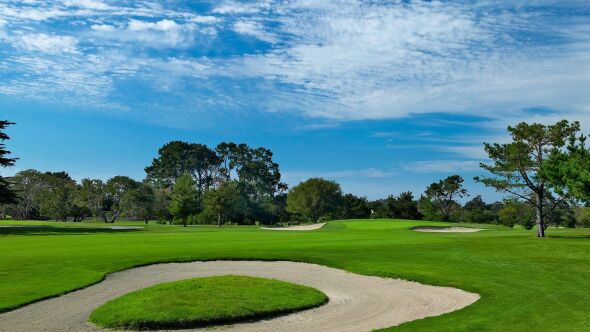
Originally designed by Chandler Egan in 1932, the first nince holes takes you through the forested areas of Pacific Grove. Egan's nine takes you through an inland terrain and reflects much of the charm of an English rural course done in the old style.
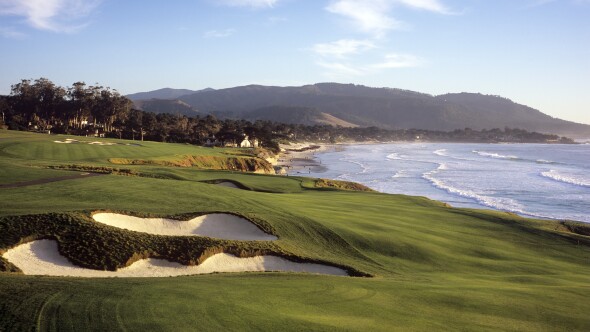
The back nine was designed by Jack Neville, the original designer of the Pebble Beach Links. It opened in 1960, and is laid out in true links design over dunesland that approaches the sea.
Over looking the course is the Point Pinos Lighthouse. Built in 1855, it is the longest continuously operating lighthouse in California. It is a historical sentinel and picturesque landmark of the golf course.
A scenic tour of the dramatic coastline provides views of Lover's Point, Point Pinos, Crespi Pond and the natural dunesland at Asilomar. You will be enchanted by the abundance of natural wonders such as the plentiful Pacific Blacktail Deer, seals, sea lions, sea otters, pelicans and gulls.
| Tee | Par | Length | Rating | Slope |
|---|---|---|---|---|
| Blue | 70 | 5727 yards | 67.9 | 113 |
| White | 70 | 5571 yards | 67.0 | 110 |
| White (W) | 72 | 5571 yards | 72.3 | 120 |
| Red (W) | 72 | 5305 yards | 70.2 | 116 |
| Hole | 1 | 2 | 3 | 4 | 5 | 6 | 7 | 8 | 9 | Out | 10 | 11 | 12 | 13 | 14 | 15 | 16 | 17 | 18 | In | Total |
|---|---|---|---|---|---|---|---|---|---|---|---|---|---|---|---|---|---|---|---|---|---|
| Blue M: 68.1/116 W: 73.5/128 | 146 | 197 | 310 | 277 | 525 | 538 | 308 | 422 | 214 | 2937 | 108 | 303 | 508 | 314 | 356 | 400 | 356 | 150 | 300 | 2795 | 5732 |
| White M: 67.1/114 W: 72.2/124 | 133 | 180 | 297 | 268 | 517 | 526 | 300 | 413 | 202 | 2836 | 100 | 275 | 481 | 298 | 343 | 385 | 344 | 136 | 293 | 2655 | 5491 |
| Combo M: 65.5/109 W: 70.1/120 | 121 | 125 | 283 | 259 | 503 | 526 | 292 | 395 | 191 | 2695 | 92 | 255 | 464 | 282 | 322 | 295 | 332 | 99 | 287 | 2428 | 5123 |
| Red M: 65.4/108 W: 69.7/119 | 121 | 125 | 283 | 259 | 503 | 475 | 292 | 395 | 191 | 2644 | 92 | 255 | 464 | 282 | 322 | 295 | 332 | 99 | 287 | 2428 | 5072 |
| Handicap | 15 | 9 | 13 | 17 | 7 | 1 | 11 | 3 | 5 | 18 | 12 | 4 | 10 | 6 | 2 | 8 | 16 | 14 | |||
| Par | 3 | 3 | 4 | 4 | 5 | 5 | 4 | 4 | 3 | 35 | 3 | 4 | 5 | 4 | 4 | 4 | 4 | 3 | 4 | 35 | 70 |
| Handicap (W) | 17 | 15 | 9 | 11 | 3 | 1 | 7 | 5 | 13 | 18 | 12 | 2 | 14 | 4 | 8 | 10 | 16 | 6 |
Course Details
Rentals/Services
Practice/Instruction
Policies
Food & Beverage
Snacks, RestaurantAvailable Facilities
ClubhouseReviews
Reviewer Photos
-
Photo submitted by Bsporken002 on 12/25/2023
-
Teeing off on the 16th Photo submitted by TedSP on 11/23/2023
-
Photo submitted by Golfboi23 on 07/03/2023
-
Photo submitted by camilas on 05/15/2023
-
Nice view too Photo submitted by uster on 01/20/2023
-
Photo submitted by u339928031 on 08/11/2022
-
Photo submitted by u339928031 on 08/11/2022
-
Photo submitted by u000004465060 on 07/23/2022
-
Photo submitted by u000003805089 on 06/09/2022
-
Photo submitted by u314162433440 on 02/05/2022
-
16th hole Photo submitted by GalCallaway on 09/26/2021
-
17 Photo submitted by johncashby on 08/01/2021
-
Photo submitted by mansperger1 on 07/09/2021
-
Photo submitted by Billservis on 11/26/2020
-
The Lake Photo submitted by u314159774881 on 10/28/2020
-
The Lighthouse Photo submitted by u314159774881 on 10/28/2020
-
Photo submitted by SherylSilveira on 10/17/2020
-
Photo submitted by gc618661817 on 08/06/2020
-
Photo submitted by scottcarnold on 07/31/2020
-
11th green at Pacific Grove Photo submitted by u1982209 on 11/20/2019
-
Photo submitted by Randy7138346 on 10/16/2019
-
Great course and great views Photo submitted by SagaWill0852 on 09/19/2019
-
Photo submitted by AlexBF on 09/04/2019
-
Photo submitted by u482709407 on 09/03/2019
-
Photo submitted by moonlight1910 on 08/29/2019
-
Awesome day with my boy. Photo submitted by veon932 on 08/10/2019
-
Photo submitted by jnooyen on 07/06/2019
-
View of bay Photo submitted by dirtcakes on 06/17/2019
-
View from driving range Photo submitted by ahanks9 on 05/16/2017
-
Tee box from hole ten on the back side of the course Photo submitted by ahanks9 on 05/16/2017
-
Photo submitted by pdicosim on 02/17/2017
-
Photo submitted by pdicosim on 02/17/2017
-
Photo submitted by pdicosim on 02/17/2017
-
Photo submitted by pdicosim on 02/17/2017
-
Photo submitted by pdicosim on 02/17/2017
-
Photo submitted by pdicosim on 02/17/2017
-
Hole 16 Photo submitted by smarshall00 on 12/12/2016
-
Photo submitted by dbfairborn on 08/18/2016
-
Photo submitted by Marlis8095927 on 06/14/2016
-
Photo submitted by Marlis8095927 on 06/14/2016
-
Photo submitted by Marlis8095927 on 06/14/2016
-
Photo submitted by Marlis8095927 on 06/14/2016
-
Photo submitted by Marlis8095927 on 06/14/2016
-
Photo submitted by Marlis8095927 on 06/14/2016
-
Photo submitted by dbshotz on 09/19/2015
-
Beautiful views at Pacific Grove golf course Photo submitted by EdnMel on 09/07/2015
-
Point Pinos lighthouse Photo submitted by EdnMel on 09/07/2015
-
Right next to 17 Mile Drive Photo submitted by leekitch on 07/25/2015
-
Photo submitted by golfkidd111 on 05/29/2015
-
Photo submitted by golfkidd111 on 05/29/2015
-
Photo submitted by golfkidd111 on 05/29/2015
-
Photo submitted by golfkidd111 on 05/29/2015
-
Photo submitted by hyperglobalmega on 06/05/2014
-
number 11 green Photo submitted by hyperglobalmega on 06/05/2014
-
Photo submitted by hyperglobalmega on 06/05/2014
-
and me Photo submitted by sfaisst on 12/08/2013
-
My wife Photo submitted by sfaisst on 12/08/2013
-
what can you say just look at that Photo submitted by Carlos7290946 on 10/10/2013
-
Across from the 17 hole. Photo submitted by dtheders on 06/23/2013
-
Deer on the 15th hole. Photo submitted by dtheders on 06/23/2013
-
I'm a happy golfer on the 18th tee. Shot an 85. Photo submitted by dtheders on 06/23/2013
-
View from 11th tee Photo submitted by mcdermott68 on 11/13/2012
-
View from 14th tee Photo submitted by mcdermott68 on 11/13/2012
-
View from 17th tee Photo submitted by mcdermott68 on 11/13/2012

Wow. Amazing.
Great staff. Amazing fairways and greens, with fluffy punishable rough. Deer everywhere you look. Powerful waves on the back 9. Can’t ask for much more, that would just be absurd. A TRUE MUST PLAY.
Pace of play
I don't know if it was because of the weather but they let too many fivesomes out at once. A lot of waiting between shots

Pleasant course
Excellent state of greens , very friendly staff . Especially back nine with ocean views have stunning views .
Classic Day
A little water earlier that week . Course was still in good shape with only a few fairway water hazards. Greens ran pretty true.
Overall excellent day . Thanks PG .
PG
Typical PG day. Front nine a little slow, back nine is beautiful. Tee boxes need some work. Greens were slow and bumpy but a fun place to spend a great fall day.
Great course!
Eric in the club house was super cool. The feel was very relaxed. Mostly locals playing which makes for a fun experience
Incredible Golf Experience
Truly enjoyed the experience of playing here. Certainly a shorter course with a number of par 4s coming in on the low end of 300 yards. Played 18 holes in 4hrs exactly, the conditions were great with no wet spots nor dry/dead zones. Because of our start time the greens still had the affect of morning dew, but by the time they dried out they were on the faster end. The back 9 was one of the most wonderful experiences I've enjoyed while playing golf, virtually every hole has a view of the ocean or of Monterey Bay. Worth every penny to play and would gladly do so again.
Sehr schöne Backnine
Die ersten 9 Löcher sind parkland artig etwas langweilig
Die 2. 9 Löcher kommen aber optisch Pebble beach sehr nahe.
Grüns waren ok aber nicht gut.
Nice backnine
Very nice links golf backnine, the front nine where parkland style, greens are bumpy an sad slow
Poor mans pebble
Back 9 is def more beautiful but front 9 wasnt bad. Wouldnt recommend for beginners, front 9 can be scary with all the houses if youre new.
Poor man’s pebble beach was amazing
Poor man’s Pebble Beach lived up to all the expectations. We started our teatime at 3:30 and I just enough time to get back before sunset front nine was really cool but the back nine was definitely The Amazing views would play here for $40 every day.





The Hyatt Regency Monterey Resort & Spa Stay & Play Package
The Inn At Spanish Bay Stay & Play Package

La Quinta Resort & Club Stay & Play Package

The Casa Palmero – Pebble Beach Stay & Play Package

